UK-USA

Mostrar mensagens com a etiqueta Carnival. Mostrar todas as mensagens
Mostrar mensagens com a etiqueta Carnival. Mostrar todas as mensagens
quinta-feira, 12 de fevereiro de 2026
sexta-feira, 2 de fevereiro de 2024
sexta-feira, 24 de fevereiro de 2012
Joan Miró, "Carnaval of Harlequin" (1924-25)

«Have you ever had a strange dream that you remembered perfectly and yet didn't understand at all? Believe it or not, you might be on your way to be a famous artist.
Shortly after World War I, a group of young artists called the "surrealists" used the unusual visions of their dreams and memories to create strange pictures, poems, and sculptures filled with fantastic images.
The surrealists were young artists and writers who went to Paris in the early 1920s. They came from all over Europe, hoping to be part of an exciting new movement in the arts. They formed a comumunity that worked and lived together.
Among the artists who practiced surrealism were Pablo Picasso, Salvador Dali, Joan Miró, and Albert Giacommetti.
In their search for ideas, these artists looked inside their minds for answers. To express themselves, they experimented with many unusual techniques, including painting with their eyes closed or turning their canvases upside down. Others would wake up in the middle of the night to paint their dreams. [...].» by Jennifer Leonard in "Highlights for children" (1994)


segunda-feira, 20 de fevereiro de 2012


The origin of the Notting Hill Carnival
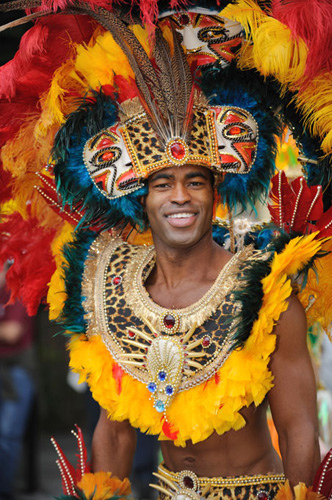
«At the roots of the Notting Hill Carnival are the Caribbean carnivals of the early 19th century – a particularly strong tradition in Trinidad – which were all about celebrating the abolition of slavery and the slave trade. The very first carnival was an attempt to showcase the steel band musicians who played in the Earls Court of London every Weekend. When the bands paraded through the streets of Notting Hill, they drew black residents out on to the streets, reminding them of the Caribbean homes they had left behind.
In the days of abolition, there was a strong element of parody in the songs and dances Trinidadians performed. Having been forbidden to hold festivals of their own during the period of slavery, they now took full advantage of the relative new freedoms the ending of slavery brought them. Dressing up in costumes that mimicked the European fashions of their former masters, even whitening their faces with flour or wearing white masks, they established a tradition that continues in the costume-making of today's Notting Hill Carnival. The proper name for this aspect of the Carnival is Mas (derived from Masquerade).»
Find more here.
domingo, 27 de fevereiro de 2011
Pancake Day

Pancake Day is celebrated on Shrove Tuesday which is the day before Lent.
"In the United Kingdom of Great Britian, Northern Ireland and several other countries around the world, Pancake Day is celebrated with fun, games, and of course a lot of eating. However, the most well known activity on this day is the Pancake Day race at Olney in Buckinghamshire, England which has been held since 1445. It all began when a woman was cooking pancakes on Shrove Tuesday to use up all of her perishables before Lent. While she was still cooking she heard the chiming of the bells calling her to church. Not wanting to be late, the woman ran to church with her apron on and the frying pan still in her hand. Little did she know that this would start a tradition that would be around for over 500 years!"Learn more about Pancake Day here.
terça-feira, 22 de fevereiro de 2011
Notting Hill Carnival
 The Notting Hill Carnival is an annual event which since 1964 has taken place on the streets of Notting Hill, Royal Borough of Kensington and Chelsea, in London.
Notting Hill Carnival is London's most brilliant celebration of colour and sound.
The Notting Hill Carnival has become an internationally acclaimed event which remains true to its Caribbean roots. Over the last four decades, it's matured into a melting pot of diverse cultural and musical genres that come together in modern West London streets.
Brazilian Carnival
Brazilian Carnival is an annual festival held forty-six days before Easter.
 It is the most famous holiday in Brazil and has become an event of huge proportions. The country stops completely for almost a week and festivities are intense, day and night, mainly in coastal cities.
Rhythm, participation, and costumes vary from one region of Brazil to another. In the southeastern cities of Rio de Janeiro and São Paulo, big organized parades are led by samba schools.
Find out more in Culture Travel World Tour Guide
New Orleans Mardi Gras (Fat Tuesday in English)

In New Orleans, Louisiana, Carnival is a well-known celebration.
Celebrations are concentrated for about two weeks before and through Fat Tuesday , the day before Ash Wednesday.
There is usually one major parade each day. The largest and most elaborate parades take place the last five days of the season. In the final week of Carnival, many large and small events occur throughout New Orleans and surrounding communities.
Find out more in Social Travellers Site
Subscrever:
Mensagens (Atom)